

Imagine a neighbour telling you at a barbecue that he bought a stock at $10 and it is now $100. By then the explanation sounds obvious. The company had a good product. There was room to expand. Management knew what it was doing.
All true, perhaps. But plenty of companies had a good product, a plan to expand and a confident manager, and their shareholders are still waiting.
So what should we have looked for before the ending was obvious?
That is the useful question behind the search for a multibagger, a stock that becomes worth several times what you paid. A tenbagger turns $1,000 into $10,000, before taxes and costs. The word describes the result. It does not tell you how to find one.
To find a candidate, you need a story about how the business could get there. We look for a company that can survive a setback, put its money to work profitably and increase what each share earns. Then we ask whether the price gives us a sensible place to start.
There is a trap, and it is worth understanding before you open a screener. Here is the best way I know to show it.
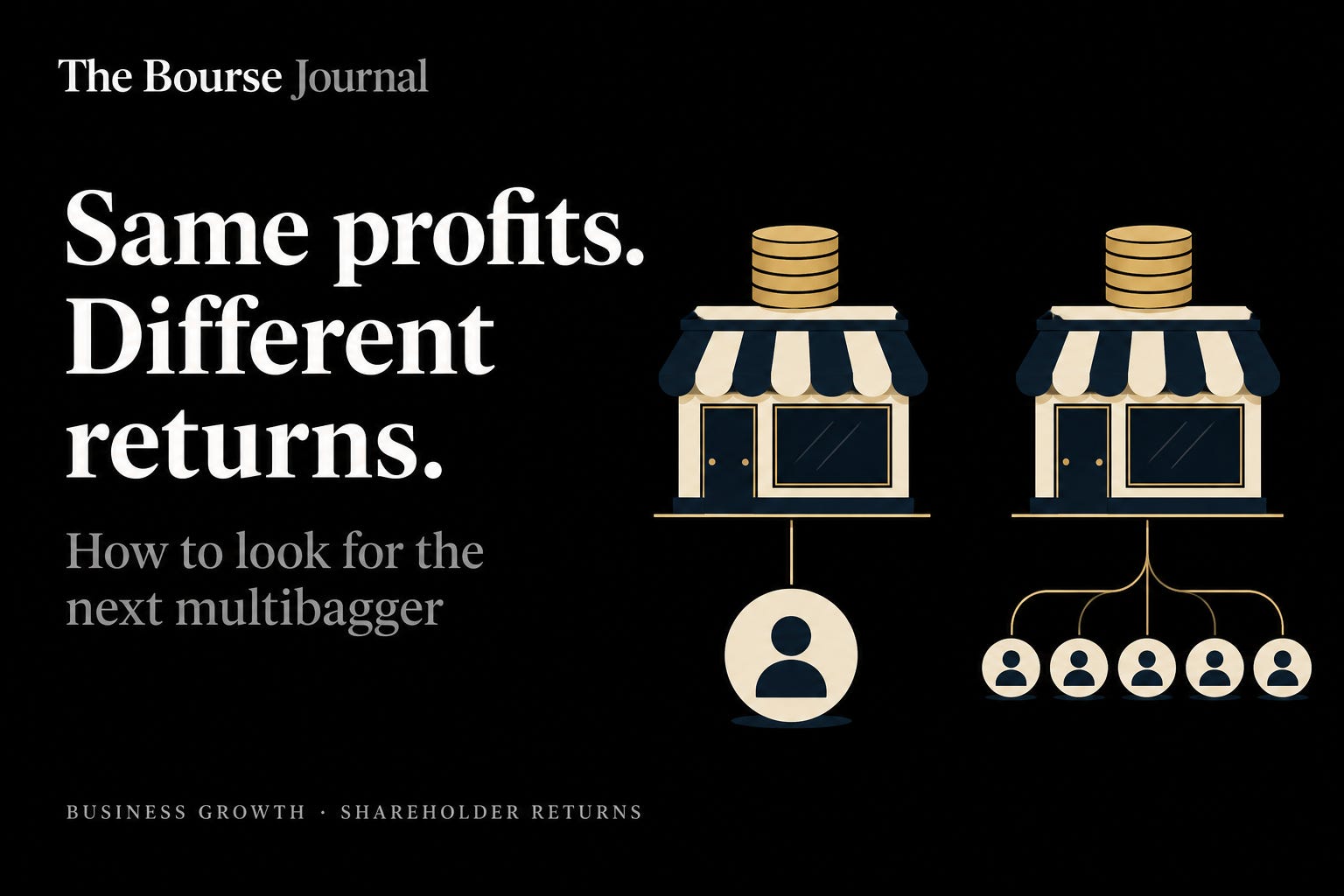
Imagine two companies. Both earn $10 million a year. Both have ten million shares. Both trade at $10 a share. Over the next ten years, each one grows its yearly profit to $50 million. Same profit. Same time. Same starting price.
One of them could turn into a tenbagger. The other could leave you with a far smaller gain.
Which one? And what makes the difference?
Subscribe free to keep reading. Next: which company wins and by how much, the two questions that quietly disappear behind every growth story, and the five checks we use before we spend time on a stock.